Percutaneous kyphoplasty for senile osteoporotic thoracolumbar fractures
Apr 02, 2022
Percutaneous kyphoplasty (PKP) is a new minimally invasive interventional technique. By forming a cavity in the vertebral body and injecting bone cement, the collapsed vertebral body can be reset and the kyphosis can be corrected. , which can increase the strength and stability of the vertebral body, and quickly reduce the pain caused by vertebral compression fractures 1,2. We performed percutaneous kyphoplasty on 28 cases of osteoporotic vertebral compression fractures (OVCF) with a total of 32 vertebral bodies. The recent clinical results were satisfactory, and the report is as follows.
1Clinical data
1.1 General information The 28 patients in this group were all patients with osteoporotic vertebral compression fractures hospitalized in our hospital, including 6 males and 22 females; aged 54-85 years old, with an average of 73.1 years old; clinical manifestations of low back pain, Difficulty walking upright, kyphosis, disease duration 3d-8w. X-ray films, CT and MR examinations were performed before operation, and the diagnosis was osteoporotic vertebral compression fracture, and fractures caused by other diseases were excluded. X-ray films were reviewed after operation. Among them, there were 24 cases of single vertebral body compression fracture and 4 cases of 2 vertebral body fractures; involved segments: T63 vertebrae, T72 vertebrae, T82 vertebrae, T91 vertebrae, T102 vertebrae, T113 vertebrae, T128 vertebrae, L16 vertebrae, L24 vertebrae, and L31 vertebrae. There were no symptoms and signs of spinal cord and nerve root compression.
1.2 Instruments and equipment PKP minimally invasive instrument set and special balloon from Kyphon Company of the United States; medical bone cement produced by Tianjin Synthetic Materials Industrial Materials; image monitoring equipment is C-arm X-ray machine.
1.3 Operating techniques Local anesthesia was used, prone position, and the thoracic puncture needle was inserted into the vertebral body through the pedicle, and the lumbar spine was inserted into the vertebral body through the pedicle. The X-ray is kept parallel to the endplate of the vertebral body. The shape of the pedicles on both sides must be symmetrical, and the distance from the spinous process must be the same. Mark the projections of the skin of the bilateral pedicles. Routine sterilization and laying of sheets, after local anesthesia, the puncture needle is pierced from the outer upper edge of the pedicle projection circle to the inner and lower sides, and the depth of piercing into the bone is about 3.0 cm. The needle tip should still be located in the pedicle projection circle. 10 o'clock on the side, 2 o'clock on the right. The lateral view shows that the puncture needle is located in the center of the pedicle. Under fluoroscopy, the guide needle continues to be drilled from the outside of the pedicle (thoracic spine) or from the inside of the pedicle (lumbar spine). When the lateral view shows that the needle tip reaches the posterior wall of the vertebral body, the front view shows that the needle tip is located at the medial edge of the pedicle shadow, indicating that the needle insertion direction is correct, and it can continue to drill for 2-3 mm and then stop. Pull out the inner core of the puncture needle, insert the guide needle, pull out the puncture needle, and place the expansion sleeve and the working sleeve along the guide needle in sequence, so that the front end of the working sleeve is located 2-3 mm in front of the posterior cortex of the vertebral body. The bone drill is slowly drilled through the working cannula, so that the tip of the drill bit reaches the anterior edge of the vertebral body in the lateral position, and is close to the edge of the spinous process in the frontal position. It is inclined forward and downward, located at the anterior 3/4 of the vertebral body, and the contralateral puncture and balloon placement are completed in the same way. Connect the injection device, fill the balloon with contrast agent to expand the balloon, the C-arm machine monitors the balloon expansion and fracture reduction, and stops increasing the pressure when the vertebral body is fully reduced or the balloon reaches the cortex around the vertebral body, and the pressure generally does not exceed 300psi. The volume of one airbag should not exceed 3ml. The balloon was removed, and the bone cement in the drawing stage was injected into the vertebral body under fluoroscopy to prevent leakage of the bone cement.
2 Treatment results
2.1 Intraoperative and postoperative conditions After the operation, patients were placed in a supine position for 6 hours, and 24 hours later, they got up and walked on the ground. In this group, 28 patients had no intraoperative complications such as pulmonary embolism and hypotension, and no intraoperative death. Postoperative X-ray showed a small amount of bone cement leakage in the lateral and anterior sides of the vertebral body, but none of them caused clinical symptoms, and no nerve root and spinal cord injury were found.
2.2 Postoperative symptom improvement 28 patients were followed up for 1-5 months, with an average of 3 months. Complete pain relief was achieved in 20 cases and partial pain relief in 8 cases. The patients with low back pain were compared before and after surgery with reference to the Visual Analog Scale (VAS) 3 for the measurement of clinical pain developed by the National Institutes of Health. 0 points: 0cm, no pain, no pain; 2 points: 1-3cm, mild pain, does not affect work and life; 4 points: 4-6cm, moderate pain, affects work, but does not affect life; 6 points : 7-10cm, severe pain, severe pain, affecting work and life. Before and after the treatment, the patients marked a 10cm line according to their own pain. The results showed that there was a significant difference in the VAS score before and after surgery.
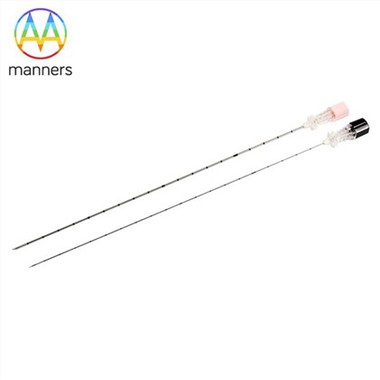
If you have any questions, please contact us. Our company can produce various customized needles, medical needles, puncture needles, hypodermic needles, biopsy needles, vaccine needles, injection needles, syringe needles, veterinary needles, pencil point needle, ovum pick up needles, spinal needles, etc. If you need customized needle products, please contact us. We look forward to your inquiry! The quality of the products manufactured in our factory will surely satisfy you!
Please contact us if you need: zhang@sz-manners.com